|
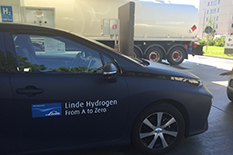
Hydrogen fuel cells produce zero-emissions, which is a strong incentive for using them in transportation and portable power applications. The Center for Risk and Reliability (CRR) at the University of Maryland is conducting risk and reliability research on hydrogen fuel infrastructure and hydrogen vehicles.
Katrina Groth, an assistant professor in the Mechanical Engineering Department, is assessing risk and reliability for hydrogen systems in a number of areas, including storage, delivery, and distribution. Groth, who is also a core faculty member of CRR, is advancing hydrogen codes and standards, as well as models and data to enhance a larger understanding of hydrogen safety.
In her paper, “HyRAM: A methodology and toolkit for quantitative risk assessment of hydrogen systems” (cowritten with Ethan Hecht while she was at Sandia National Laboratories and published last year in the International Journal of Hydrogen Energy), Groth describes a methodology and accompanying software toolkit, which provides a platform for integration of state-of-the-art, validated science and engineering models and data relevant to hydrogen safety. In her new role as an assistant professor, she is using this work as a foundation for broader research into using diverse sources of data to inform risk assessment for complex systems.
“The HyRAM toolkit offers a standard methodology for conducting quantitative risk assessment and consequence analysis for assessing the safety of hydrogen fueling and storage infrastructure at the design and permitting stage,” she explains. “It integrates science and engineering models from multiple disciplines and puts it in the hands of the decision makers who are developing standards to enable these technologies.”
This is just one example of how risk and reliability research can enable better engineering decisions. CRR researchers pursue a wide breadth of topics involving systems and processes. They are advancing risk analysis theory and applications to complex systems such as civil infrastructures, information systems, medical devices, nuclear power plants, petro-chemical installations, civil aviation and space missions. Predictive reliability modeling and simulation, physics of failure fundamentals, software reliability and human reliability analysis methods, advanced probabilistic inference methods, system-level health monitoring and prognostics are also important areas of CRR research.
For more information, visit http://crr.umd.edu/.
November 2, 2018
|