
|
 |
High school STEM educators Lovely Rose Fantilanan and Jennifer Wade spent their summer at UMD conducting research on sustainable cooling technologies. |
|
Two Maryland high school STEM educators headed back to their classrooms this fall equipped with hands-on engineering experience — and fresh insights into advances in air-conditioning and data center cooling — thanks to a summer Research Experience for Teachers (RET) at the University of Maryland. UMD engineering students and postdocs guided the teachers through their projects, strengthening their own technical understanding and gaining leadership experience along the way.
For Jennifer Wade, a teacher at Bethesda-Chevy Chase High School in Montgomery County, the program offered a real-world glimpse into the engineering design process. After teaching science and computer science for nearly 25 years, she recently transitioned to a role as an engineering and technology educator. “I’m still new to teaching engineering, and I wanted to get a real feel for what you do every day as an engineer,” she said.
Wade, along with Lovely Rose Fantilanan, a STEM educator at International High School at Langley Park in Prince George’s County, participated in a five-week RET program offered through the Environmentally Applied Refrigerant Technology Hub (EARTH). EARTH is a National Science Foundation-funded engineering research center that brings together six universities, including UMD, to develop more efficient and sustainable heating, cooling, ventilation, air-conditioning and refrigeration (HVAC&R) technology. Two other EARTH institutions — the University of Kansas and the University of South Dakota — also offered RET opportunities this summer.
A solid foundation in solid-state cooling
For her project, Wade collaborated with a UMD research team developing a cooling system that could revolutionize the HVAC&R industry. While conventional air-conditioning relies largely on refrigerants — many of them potent greenhouse gases — the UMD team is advancing a solid-state approach that uses metals instead and would have zero direct global warming potential. Known as elastocaloric cooling, the technology relies on shape memory alloys (SMAs) that can be compressed and then released to return to their original shape. SMAs release heat when compressed and absorb heat when relaxed, producing a cooling effect.
![]() 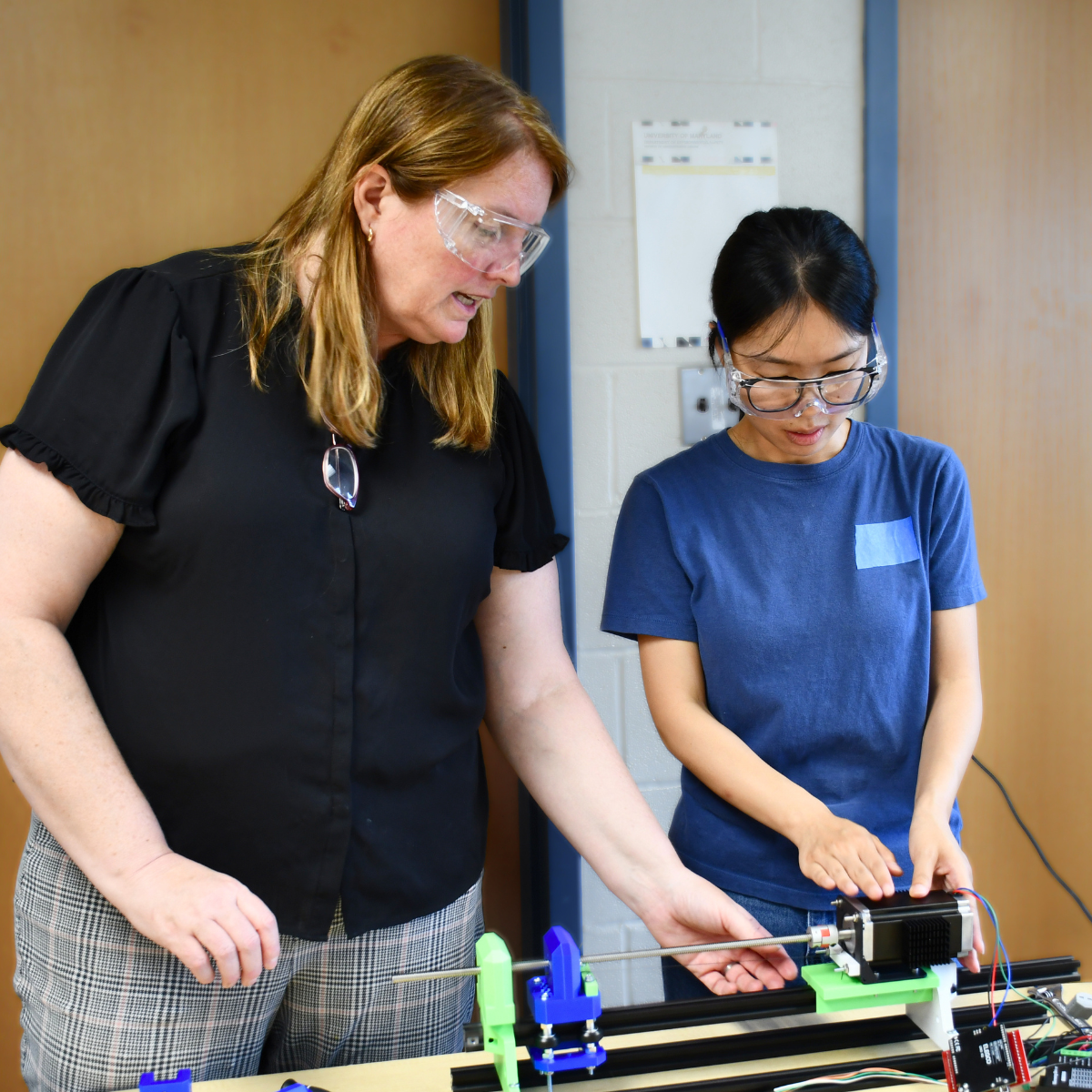 CEEE graduate research assistant Boyang Liu (right) helped high school teacher Jennifer Wade troubleshoot design challenges on an elastocaloric dehumidifier prototype. CEEE graduate research assistant Boyang Liu (right) helped high school teacher Jennifer Wade troubleshoot design challenges on an elastocaloric dehumidifier prototype.The UMD project is led by mechanical engineering Research Professor Yunho Hwang, with the Center for Environmental Energy Engineering (CEEE), and Ichiro Takeuchi, professor and chair of the Department of Materials Science and Engineering (MSE).
On a hot July afternoon, Wade presented her project: an elastocaloric dehumidifier prototype, built in part using computer-assisted design (CAD) and 3D printing. After demonstrating how a thermal sensor detects a temperature change when the prototype’s nickel-titanium cord is compressed and released, she pointed to a pile of plastic pieces nearby. “That’s my graveyard of discarded parts,” Wade said wryly. Engineering requires a level of precision often reached only through experimentation — sometimes leaving behind a pile of unusable pieces. It’s a lesson she plans to bring back to her classroom.
She also plans to incorporate efficient-cooling concepts into her aerospace engineering course. Students will explore the possibility of using elastocaloric cooling in aircraft — whether for cooling the cabin, the engine or the radar system.
CEEE graduate research assistant Boyang Liu and MSE postdoctoral associate Yuxin Song mentored Wade throughout the project. “They are both so sharp,” said Wade, noting how the UMD researchers quickly spotted design issues and helped her troubleshoot. “They coached us through the process and encouraged us to figure out solutions.”
As a doctoral student, Liu also benefited from the experience. “Working with the RET teachers gave me the opportunity to be a mentor,” she said. “Jenn [Wade] is a fast learner and is always enthusiastic about learning new things. She always asks 'why,' which brings a fresh view to the project. I also learned how to plan a project step by step so it can be followed easily. This experience helps my professional growth by improving my project management skills.”
A deep dive into data center cooling
Fantilanan’s project explored efficient data center cooling strategies — a pressing concern given the rapid global growth in artificial intelligence and cloud computing. Computer servers generate significant heat that must be managed to ensure reliable operation. Elevated temperatures can degrade performance, shorten component life and increase energy consumption.
She collaborated with UMD’s Nanoscale Energy Interfacial Transport (NEIT) lab, known for its innovative research in data center cooling. The lab is led by mechanical engineering Associate Professor Damena Agonafer, who also heads the UMD EARTH team.
![]() 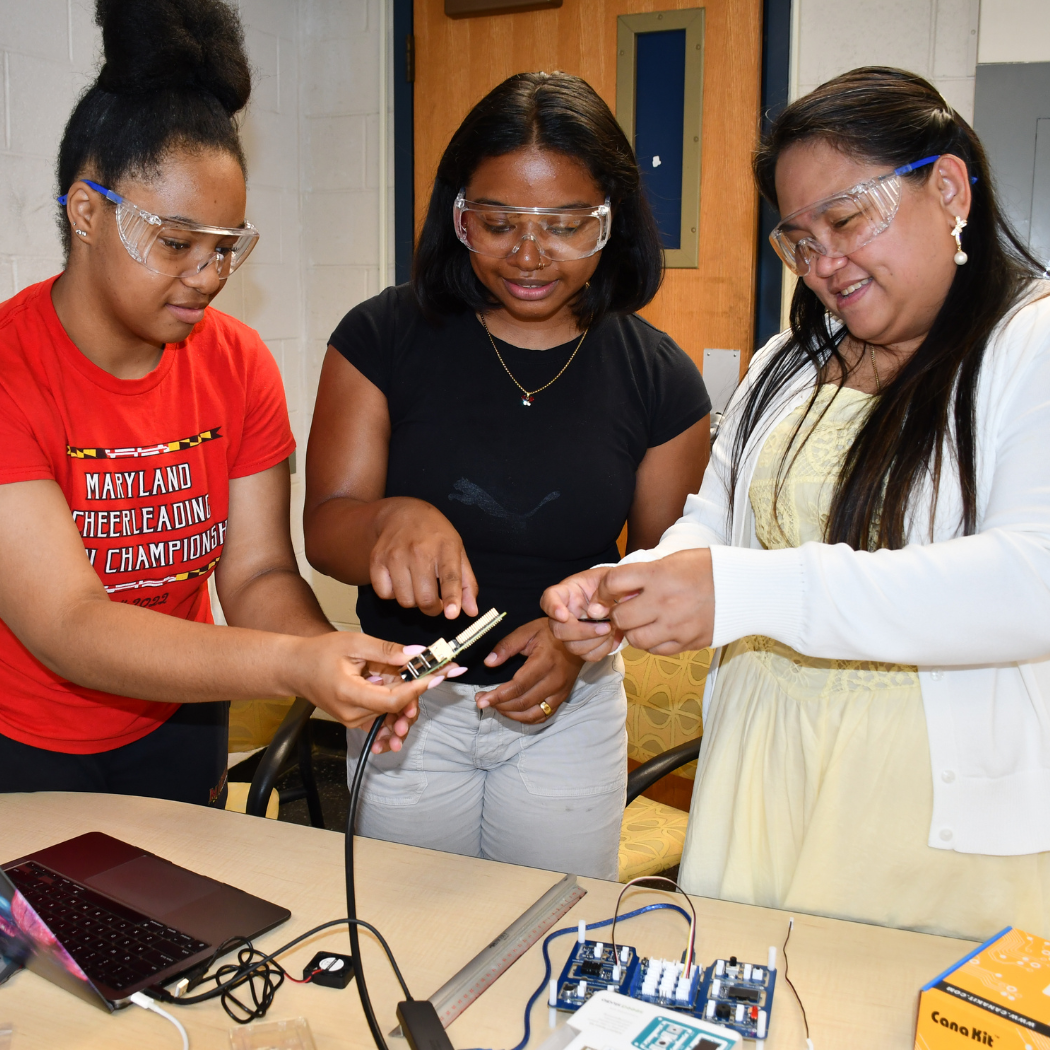 Bioengineering undergraduate student Taylor Phillips Hillian and mechanical engineering grad student Andoniaina Mariah Randriambololona helped teacher Lovely Rose Fantilanan configure a computer board for a project on data center cooling. Bioengineering undergraduate student Taylor Phillips Hillian and mechanical engineering grad student Andoniaina Mariah Randriambololona helped teacher Lovely Rose Fantilanan configure a computer board for a project on data center cooling.In Fantilanan’s experiment, a simple credit card-sized Raspberry Pi computer board stood in for the hardware at a massive data center, making the setup easy to bring back to her classroom. Over the summer, she examined and compared three cooling strategies: active cooling with an aluminum heat sink and fan; passive cooling using wax as a phase change material (PCM) that absorbs and stores heat as it melts; and a hybrid approach that combines PCM with fan-based cooling.
As a physics teacher at a school serving multilingual learners, Fantilanan has the challenging task of teaching a technical subject to a classroom full of students who are non-native English speakers. Each unit starts by introducing the related English vocabulary and concludes with a hands-on group project.
With 23 years of teaching experience, Fantilanan is a firm believer in the power of project-based learning. “I’ve been teaching at this school for 10 years, and every time a student comes back to visit, they always remember the projects,” she said. Her RET experience inspired her to build a new project-based curricular unit, "Cooling the Future: Using Physics to Design Sustainable Cooling Solutions for Electronic Devices."
The research experience also pushed her beyond her comfort zone as she mastered heat-transfer concepts, electronic configurations and CAD modeling with support from her UMD mentors. “This was my first time even seeing CAD software,” she said. “When I made my first CAD model, I felt like I had won the lottery.” Her mentors celebrated right along with her.
“One of my proudest moments was watching my RET teacher learn CAD modeling,” noted mentor Andoniaina Mariah Randriambololona, a doctoral student in mechanical engineering. “There’s nothing like that ‘Aha!’ moment when a concept suddenly clicks or you successfully complete a task that once seemed out of reach. Seeing her excitement and sense of accomplishment was incredibly rewarding and reminded me that mentorship is not just about teaching technical skills but also helping others build confidence in their own abilities.”
![]() 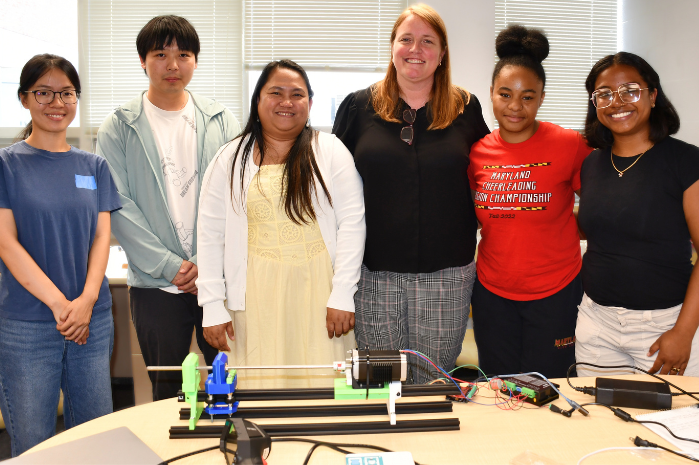 High school teachers Fantilanan and Wade with UMD mentors Boyang Liu, Yuxin Song, Taylor Phillips Hillian and Andoniaina Mariah Randriambololona. High school teachers Fantilanan and Wade with UMD mentors Boyang Liu, Yuxin Song, Taylor Phillips Hillian and Andoniaina Mariah Randriambololona.As a busy graduate student, Randriambololona also learned the importance of delegating responsibilities. She worked with NEIT lab intern Taylor Phillips Hillian, a junior bioengineering major, to guide and support Fantilanan. Hillian gained leadership skills in the process and strengthened her technical skills.
“Working with the RET teachers has honestly been one of the best parts of this internship,” said Hillian. “It is one thing to understand a concept yourself, but trying to explain things like thermal resistance or phase change materials to someone else forces you to actually master the material. Honestly, it was a two-way street; while we helped the teachers with the hardware and CAD modeling, they showed us how to be better communicators and mentors.”
Related Articles:
Vikrant C. Aute Appointed CEEE Director
CEEE Co-Director Vikrant Aute Honored With Faculty Award
August 24, 2026
|




