|
 |
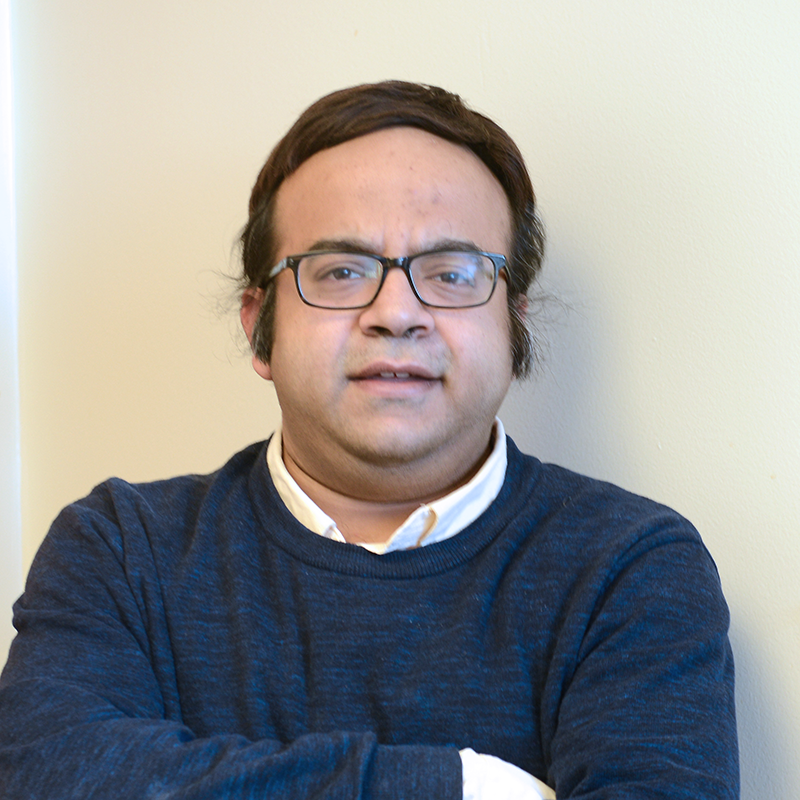
Professor Siddhartha Das, UMD Department of Mechanical Engineering |
|
Professor Siddhartha Das and doctoral student Raashiq Ishraaq have co-authored a new paper that provides a timely perspective on the use of machine learning (ML) to explore properties and applications of polymer and polyelectrolyte (PE) brushes.
Polymer and PE chains form brush-like configurations when they are densely grafted onto solid surfaces or the backbones of other polymer chains. Das and his team are interested in how the configurations, which are highly responsive to environmental stimuli, may be “functionalized”—that is, harnessed for various purposes, including drug delivery and oil extraction.
The new paper, "Machine Learning for Probing Polymer and Polyelectrolyte Brushes," was published by Trends in Chemistry in November. It looks at how ML approaches can be used not only to optimize polymer and PE brushes for specific uses, but also to add to fundamental knowledge about them.

Doctoral candidate Raashiq Ishraaq.
ML can be used to sift through the massive amounts of data generated by all-atom molecular dynamics (MD) simulations. Prof. Das and his group were among the first groups to employ all-atom MD simulations for probing the behavior of the PE brushes and the brush-supported counterions and water molecules.
Similarly, Das and his group was the first to employ ML on the all-atom MD data on PE brushes. For example, adapting a technique pioneered by Piero Gasparotto and Michele Ceriotti, Das’s team has used unsupervised clustering methods to recognize molecular patterns, thereby pinpointing the changes in the water-water hydrogen bonding inside the PE brush layer. In a separate group of papers, Das and his group employed a combination of Gaussian pre-processing of data and unsupervised clustering on all-atom MD data on PE brushes to identify various interesting facets of hydration (water-interaction) behavior of different functional groups of the PE brushes.
“The coupling of ML with explainable artificial intelligence will enhance interpretability in PE brush research, providing predictions and mechanistic insights into how brush conformation, electrostatics, and solvent effects co-regulate different functions,” the authors said. “This will be especially valuable in biomedical contexts such as biosensing, lubrication, or targeted drug delivery, where optimizing brush-biomolecule interactions is crucial.”
A member of the UMD faculty since 2014, Das has received widespread acclaim for his work on polymer and PE brushes, nanochannels, and other phenomena that occur at scales too small for the eye to see. Recent recognitions include being elected a Fellow of the American Physical Society (APS) in recognition of his research on PE brushes and induction as a Lifetime Fellow of the International Association of Advanced Materials.
Ishraaq, who graduates this fall, has garnered significant accolades during the past year, including selection as a finalist for the APS Division of Soft Matter Emerging Soft Matter Excellence Award.
December 2, 2025
|




